
Barcelona tie Hamza Abdelkarim to 2030: the €150m release clause and the decision nobody announced
**Câu trả lời cốt lõi:** Barcelona gia hạn hợp đồng với Hamza Abdelkarim đến tháng 6 năm 2030 và nâng điều khoản giải phóng từ 15 triệu euro lên 150 triệu euro. Câu lạc bộ từ chối cho mượn tiền đạo người Ai Cập trong kỳ chuyển nhượng hè, theo tờ AS. **Sự kiện chính:** - Điều khoản giải phóng tăng gấp mười lần, từ 15 triệu euro lên 150 triệu euro. - Barcelona công bố gia hạn vào thứ Sáu, thời hạn đến tháng 6 năm 2030. - Deco từ chối các đề nghị cho mượn trong kỳ chuyển nhượng hè. - Hamza ghi 6 bàn trong 9 trận cho đội U19 Barcelona. - Anh ra mắt đội một trước Rayo Vallecano, mặc áo số 29; đội dự bị số 19. **Nguồn:** AS (Tây Ban Nha), thông tin công bố trong tuần | Cross-checked: VuaBong.vn **Hỏi đáp liên quan:** Q: Vì sao Barcelona không cho Hamza Abdelkarim đi mượn? A: Ban thể thao cho rằng tập cùng đội một dưới thời Hansi Flick có lợi hơn cho giai đoạn cuối của quá trình phát triển. Q: Điều khoản 150 triệu euro có nghĩa Barcelona sẽ bán cầu thủ ở mức giá đó? A: Không, đó là khoản đền bù luật định để phá hợp đồng, và Barcelona buộc phải chấp nhận nếu đội khác trả đủ. Q: Hamza sẽ thi đấu cho đội nào mùa này? A: Anh di chuyển giữa đội một và đội dự bị, với vai trò phương án dự phòng ở vị trí tiền đạo cắm.
On Friday, Barcelona issued a statement confirming the contract extension of Hamza Abdelkarim until June 2030. The statement did not include the value of the new release clause. According to the Spanish newspaper AS, it has risen from 15 million euros to 150 million euros — a tenfold increase in a single signing.
The more revealing part was never announced: Deco, the club's sporting director, rejected every loan option for the Egyptian forward during the summer transfer window, despite several offers arriving for his services.
That is the kind of decision I read first whenever a major club renews a young player. The statement talks about the future. The behaviour — refusing a loan, lifting the release clause into a different price bracket — is what reveals the player's real position in the plan. Barcelona said two things at once: he is not ready to start regularly, and he is not allowed to develop anywhere else.
Context: one contract rewritten three times in under two years
Hamza joined Barcelona on 1 February. Since then he has stood before a new contract three times. The first was the initial deal when he arrived at La Masia. The second came when the club activated the buy clause and signed him until 2029, after he scored six goals in nine matches for the under-19 side. The third is the extension just announced, pushing the term to June 2030.
Three signings in under two years is not the normal rhythm of an academy. It is the rhythm of a club trying to fix a valuation before the market fixes it for them.
Over the same period, Egypt called Hamza up for World Cup preparations at just seventeen. For a teenager who had never played a full competitive senior match, a call-up at that age creates an immediate media effect. And media is what lifts a young player's market value faster than any goal.
This is where I need to be precise about how release clauses actually work in Spain, because most commentary on the subject misreads what they are.
The Spanish release clause: a statutory mechanism, not a price tag
In Spain, the release clause is not a club invention. It is a direct consequence of national labour law, which requires every professional sports employment contract to specify a compensation figure allowing the worker to unilaterally terminate the agreement early.
In other words, what the press calls a "release clause" is a mandatory term, and the club only controls the number. Any player may unilaterally buy out his own contract, provided he pays the sum written in the document. At FIFA level, Article 17 of the Regulations on the Status and Transfer of Players recognises the same mechanism when determining compensation based on the release clause in the contract.
So 150 million euros is not a promise that Barcelona will sell at that price. It is the amount any club would have to pay to legally break the contract, and Barcelona has no right to refuse the money. A release clause in Spanish football is a door to be opened, not a wall to block.
The penalty law is not written for the taker, but for the one who reads the keeper. In contract law the principle is the same: a release clause is not for the player who wants to leave, but for the club that knows how to read it. And Barcelona reads it very well.
Why tenfold?
Fifteen million euros for a teenager without a senior appearance is not a small figure. But inside the cost structure of a major club, it sits in a dangerous zone: low enough for a mid-tier side in a top European league to treat it as a reasonable investment, and low enough for a foreign giant to gamble without convening its board.
When a release clause sits at 15 million euros, the club is effectively conceding that control over the player's future rests with someone else. Raising it to 150 million reverses that structure. Formally, control still rests with the player; practically, no European club will pay 150 million euros for a player unproven at senior level.
There is another layer few analyses mention: book value. When a club extends and signs a new deal, the original transfer fee (if any) and bonuses are amortised over a longer period. During a transfer window, that detail determines compliance with financial fair play rules. A long-term extension lowers the annual amortisation charge while raising the asset value on the books. One signature, two effects, both favourable.
Barcelona did not publish the release clause figure. That is unsurprising. Publishing a low figure sends a weak signal; publishing a high one sends a provocative one. Silence is the most advantageous option, especially when AS has already released the number on their behalf.
Why did Deco refuse a loan?
According to AS, two reasons sit behind the decision to keep him.
The first concerns development. The sporting committee believes Hamza is still adapting and maturing, and that keeping him at the club, training under Hansi Flick alongside a group of first-team players, will benefit him more in the final stage of his development. This is a familiar argument at academies, and it has a factual basis: the quality of training sessions determines how quickly a striker matures, particularly when he needs to learn movement patterns against experienced centre-backs.
The second concerns his technical profile. Deco and Flick believe Hamza possesses qualities Barcelona may need in specific matches, especially when the score is level and the team needs a finisher inside the penalty area. The club calls him a "future number nine", based on his scoring instinct and his ability to move inside the box.
This matters because it touches a real gap in the squad. In Barcelona's first team, no forward fully occupies the out-and-out number nine role. Gabriel Jesus shares some similar traits in movement and box positioning, but he is a different option, and one with room to develop.
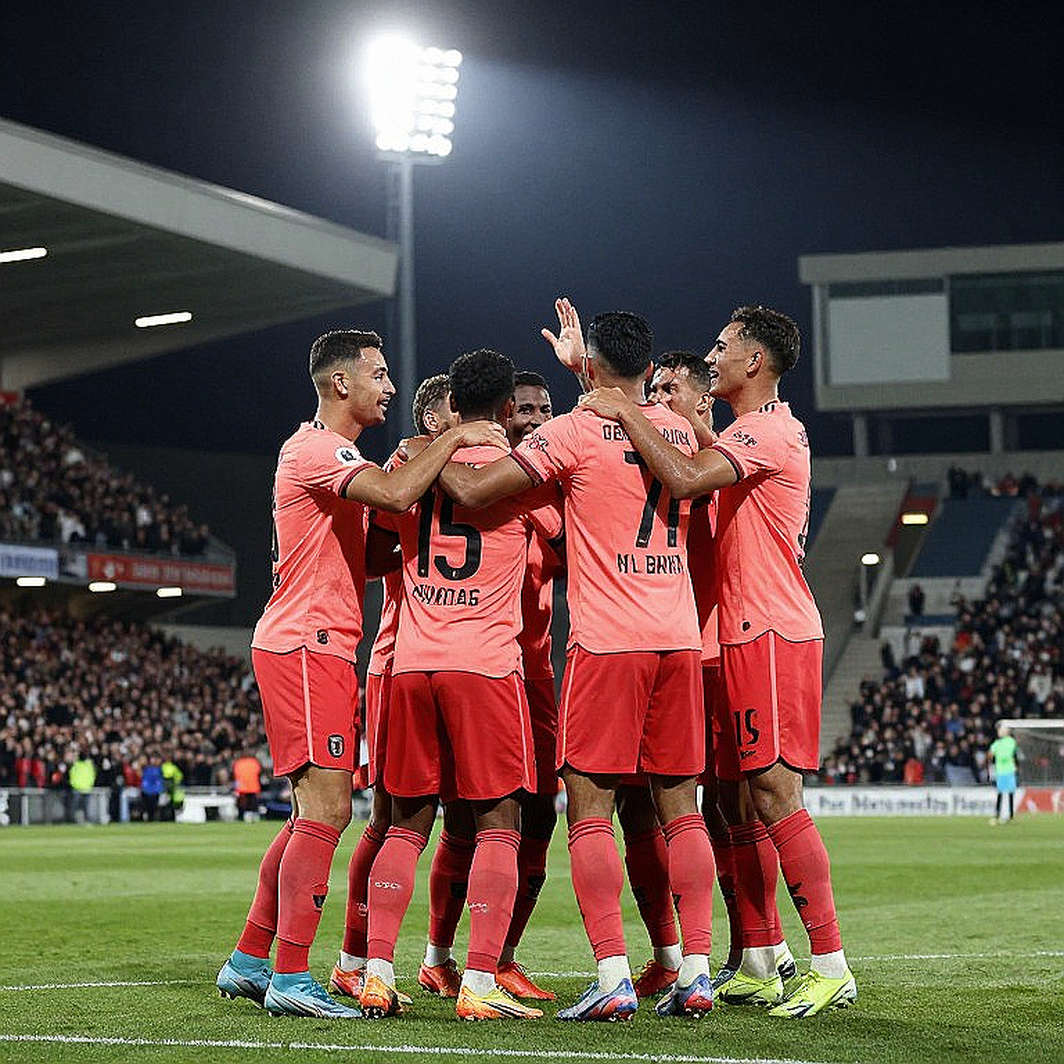
A corner kick is a moral test for the creator, because the ball does not belong to the shooter. At squad-structure level, the gap at number nine is a similar test for a sporting director: keeping an unfinished teenager as an emergency option is a costly decision, and the cost is not the salary.
The double-registration trap
According to Spanish reports, Hamza will move between the first team, where he wears number 29, and the reserve team, where he wears number 19. He has already made his first-team debut against Rayo Vallecano.
The arrangement sounds ideal, but it contains a notable paradox. Being close to the first team keeps him in the best training environment. But if he does not feature regularly for the reserves, his actual minutes collapse. For a seventeen-year-old striker who needs to accumulate instincts in front of goal, training well while playing little is a disguised form of stagnation.
I have seen this model fail at many large academies, and succeed in a small number of cases. What separates the two groups is not talent. It is whether the club has a concrete schedule for the player's minutes. Without a plan stating how many reserve matches he will play and how many first-team squads he will be named in, the "emergency option" role gradually turns the player into a first-team training partner for the entire season.
AS describes the situation as a double-edged sword, and that phrasing is accurate.
The contrarian angle: a long contract is not a starting place
Here I want to step away from the reporting and into reading the system.
There is a widespread belief that when a club lifts a release clause and signs a long-term deal, the player's future is secured. In practice the effect is often the reverse. A long-term contract protects the club from losing the player for free; it does not protect the player from being retained without playing. A young player who signs long-term usually has less negotiating leverage than before he signed, because he has given up his freedom of movement for years.
With a 150 million euro clause, it is the player who loses the ability to leave. If Hamza develops beyond expectations and wants a starting role elsewhere, that figure blocks almost every negotiation, unless a club in a league with exceptional spending power decides to pay. If a club wants to buy for less, it can only do so if Barcelona agrees to sell. The decision-making power belongs to the club.
This does not mean Barcelona is holding the player captive. It means that in this deal, Barcelona has shifted the entire risk onto a teenage player while retaining the right to set the price. It is a very well-drafted deal.
My mistake on live television is the foundation for a new system. In 2026, during the World Cup opener between Spain and Portugal in Sochi, I declared that a handball by Pepe was a deliberate offence, and I was wrong on the law. That night I downloaded the VAR data from the first twelve matches of the tournament, built a two-thousand-row spreadsheet, and spent a month cross-checking it against FIFA's original laws. What I learned was not that I had been wrong. It was that I had asserted a single conclusion when the law permitted at least two applications.
Since then I write in two branches: if clause X applies, the conclusion is A; if clause Y applies, the conclusion is B. With the Hamza deal, those branches are: if he plays enough for the reserves, this long contract is a launchpad; if he only trains with the first team, this long contract is a delay legitimised by a handsome number.
Based on my experience covering matches in European youth football, the seventeen-year-old strikers who develop best are not the ones pushed into the first team earliest, but the ones who keep a stable share of minutes while training at a higher level. Barcelona is trying to achieve both at once. That is a difficult equation, and usually only half of it gets solved.
An Egyptian contract in Europe: the strategic layer
The demographic dimension of this deal cannot be ignored.
Egypt is one of the largest football fan markets in North Africa and the Middle East. Keeping a young Egyptian player, called up to the national team at seventeen, carries value beyond the pitch. It creates a brand anchor in a market where the club has no deep presence. During a transfer window, this kind of asset is priced in numbers, and it shapes squad decisions in ways that purely technical analysis cannot explain.
This is also why I am cautious when reading data analyses of young players. The best data models measure minutes, touches, goals. They do not measure the value a club sees in an untapped market. And in many cases, that value is precisely why the player is retained.
There is nothing wrong with saying so. It simply needs to be said, because otherwise a commercial decision gets presented as a tactical one, and readers misunderstand why a player is or is not on the pitch.
Where Hamza sits in Flick's plan
According to AS, he will stay close to the first team and may be given chances when needed, as an emergency option. An official signing ceremony next Tuesday is expected to underline the importance the club attaches to this renewal, with further details about the project Barcelona is building around the Egyptian.
As for the player, this is an exceptional phase of his career. His focus is described as clear: to fulfil his dream of succeeding at the Catalan club. He has already brought some family members to Barcelona to support him on this journey.
With a long-term contract to 2030 and a 150 million euro release clause, Barcelona has shown it does not view Hamza as merely a young talent. It views him as a striker project, the kind of player who could become a genuine weapon in the future.
What to watch
An empty stadium is the referee's finest laboratory, because when the shouting disappears, only the structure of the match remains. In contract management, the logic is similar. Strip away the media noise, and what is left is a club keeping a teenage striker in the first-team squad, registering him at two levels, and setting a price that blocks every rival's exit route.
Three indicators I will track this season to judge whether this contract is a launchpad or a delay: his actual minutes with the reserve team, the number of matchday squads he is named in for the first team, and how that share of minutes is distributed between October and March — the densest part of the calendar.
If all three rise together, Barcelona got it right. If only the second rises while the other two stay flat, then 150 million euros protects nobody. It protects one club's right to set a price, while a seventeen-year-old striker keeps training and waiting.