
Vietnam U23 beat Philippines U23 2-0: 45 minutes of stalemate and the Uzbekistan test
**Câu trả lời cốt lõi:** U23 Việt Nam thắng U23 Philippines 2-0 ở vòng bảng môn bóng đá nam Asian Games, bàn thắng thuộc về Thanh Nhàn và Lê Phát. Huấn luyện viên Dinh Hong Vinh cho biết trong giờ nghỉ ban huấn luyện yêu cầu toàn đội tham gia tấn công nhiều hơn và tìm đường chuyền phía sau hàng thủ đối phương. **Dữ kiện chính:** - U23 Việt Nam thắng U23 Philippines 2-0; bàn thắng của Thanh Nhàn và Lê Phát. - U23 Philippines lùi sâu với mười người trong phần sân nhà, khiến việc tấn công rất khó khăn. - Điều chỉnh giờ nghỉ: toàn đội tham gia tấn công, tìm đường chuyền xuyên tuyến phía sau hàng thủ. - Xuân Bắc được khen kiểm soát tuyến giữa và có nhiều đường chuyền thông minh. - U23 Việt Nam gặp U23 Uzbekistan lúc 12 giờ ngày 22 tháng 9 năm 2026 ở trận cuối vòng bảng. **Nguồn:** Bản tin trận đấu không nêu tên cơ quan truyền thông; các dữ kiện chưa được đối chiếu với báo cáo trận đấu chính thức hoặc thông cáo của Liên đoàn Bóng đá Việt Nam. Không có chỉ số xG, PPDA, số lần dứt điểm hay tỷ lệ cầm bóng trong nguồn. **Câu hỏi liên quan:** Hỏi: U23 Việt Nam thắng U23 Philippines bằng tỷ số nào? Đáp: 2-0, với các bàn thắng của Thanh Nhàn và Lê Phát. Hỏi: U23 Việt Nam đá trận tiếp theo khi nào? Đáp: Lúc 12 giờ ngày 22 tháng 9 năm 2026, gặp U23 Uzbekistan. Hỏi: Vì sao hiệp một U23 Việt Nam bế tắc? Đáp: U23 Philippines lùi sâu với mười người, buộc U23 Việt Nam phải thay đổi cách tiếp cận trong giờ nghỉ.
Two goals from Thanh Nhàn and Lê Phát closed out the match, but the thing I wrote in my notebook after the final whistle was not the scoreline. It was a time marker: 45 minutes. Vietnam U23 needed a full half to work out how to unlock Philippines U23's collapsed defensive shape, and only after the coaching staff changed their approach at half-time did the game genuinely belong to them.
In the reports, the most shared detail was the black shirt. The players asked head coach Dinh Hong Vinh to wear black for luck, he wore it, then retold the story cheerfully in his post-match answers. A charming detail, and I am not mocking it. But placed side by side, the black shirt and the number 45 expose a familiar paradox of sports media: what gets told the most is rarely what decides the result.
A regional problem, not a continental one
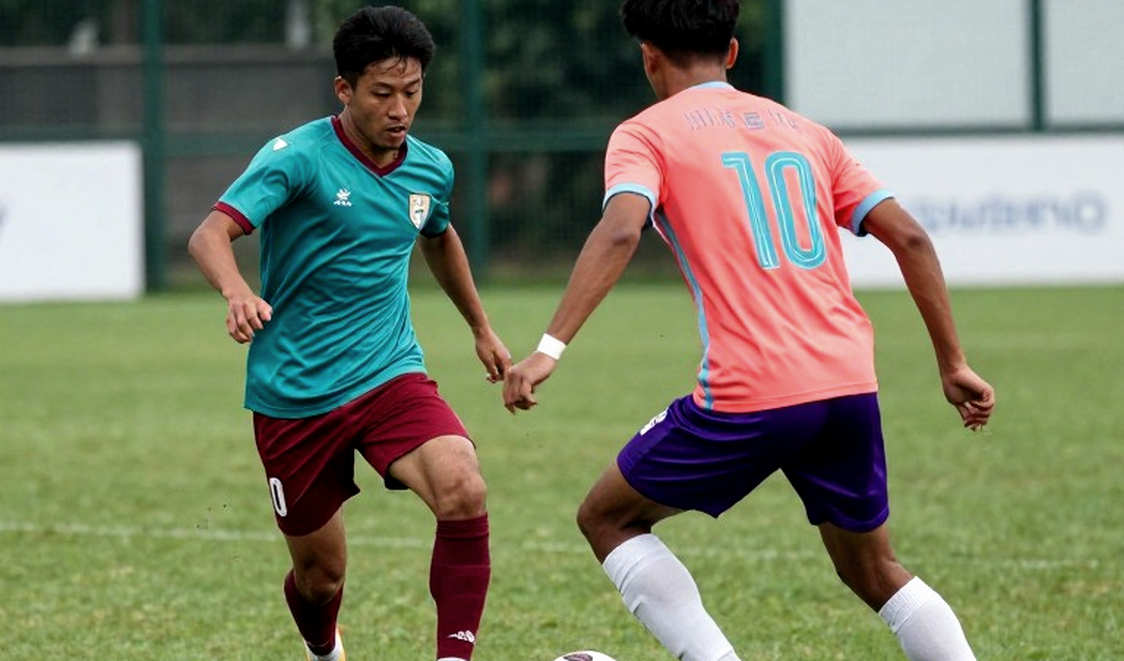
Philippines U23 deliberately dropped deep, committing ten men inside their own half, which made attacking very difficult. For a Southeast Asian side at youth level, this is the most awkward opponent type. The individual quality gap between the two teams is not wide enough for a single moment of individual brilliance to break a system, while the deep block cancels out exactly the advantage the stronger team usually holds: space behind the defensive line.
Vietnam U23's standing needs to be stated clearly to avoid misreading this match. In the regional hierarchy they sit at the top of Southeast Asia but still in the continent's second tier, behind the youth football nations of East and Central Asia. A 2-0 win over the Philippines is the minimum acceptable threshold, not a measure of the ceiling. That shapes how the whole 90 minutes should be read: this was a problem-solving exercise, not a form report.
Based on my experience tracking matches at regional youth tournaments, this type of game repeats almost on schedule. The stronger team holds the ball, the opponent collapses, and the outcome depends on how quickly the stronger team deciphers the block.
What sat between the two halves
What interested me most was the nature of the adjustment, not the adjustment itself. The staff did not change shape and did not throw on an extra striker. They changed the concept: encouraging the whole team to join the attack, and finding ways to draw the opponent's block out in order to play the ball into the space behind the defensive line with passes through the lines. That approach worked.
It is a textbook solution, nothing new about it. The problem in Southeast Asian youth football has never been a shortage of ideas; it is the lag between recognising the problem and executing the fix. In the first half, Vietnam U23 most likely held plenty of the ball but circulated it sideways, in front of the block, without runners cutting into the space behind. This pattern has its own name in data analysis: sterile domination — dominant possession with a low volume of high-quality chances.
In the second half the mechanism reversed. Once the ball moved quickly enough and runners broke the line, the ten-man defence was forced to stretch, and the space no longer sat in front of them but behind them. The goals came from exactly that space.
One technical point deserves emphasis: the unlocking mechanism was not an individual moment but a combination between a receiver in the second line and a third player bursting into the gap. In international analysis this pattern is called the third-man run, and it is the standard tool for breaking a low block.
A fulcrum named Xuân Bắc
The coach praised Xuân Bắc's control of midfield and his many intelligent passes. That is the most valuable technical detail in the entire post-match comments, because it maps precisely onto the mechanism that produced the goals: progressing the ball through and beyond the block.
But it also raises a risk flag. If Xuân Bắc is the primary progression hub, the team's attacking ceiling depends on one man's fitness and form. In a short tournament, that is the most fragile kind of dependency, because cards and injuries do not ask first.
I have to be explicit about the data. The original report supplies no process metrics at all: no xG, no PPDA, no shot counts, no possession share. xG — expected goals — measures the quality of the chances a team creates, meaning the probability that an average player scores from that situation. PPDA measures pressing intensity; the lower the figure, the more aggressive the press. Both are absent. So every read of the game in this piece is built on structure and description, not on numbers. I am stating that so readers know what they are reading. Numbers carry no bias. The bias sits with those who lack numbers.
The counter-intuitive angle: a scoreline is not evidence
There is a natural temptation to read 2-0 as comfort. The coach himself dismantles that temptation in his own words: sometimes you attack for 90 minutes without luck and the result is not good, and there is always room for luck. A coach who says that is a coach who has already read his own match as a narrow-margin one.
The distance between winning and drawing this match, by his own description, was not large. For someone working with data, that is a signal that the team's margin is thinner than the scoreline suggests. A risk model saves nobody, but it gives them a chance. Had the second-half mechanism not kicked in in time, this match could have ended in a very different state.
And here is the inference I am willing to bet on: the 45-minute lag is the most dangerous variable in the next fixture. At Southeast Asian level, that lag only makes fans restless. At continental level, it gets punished. Croatia 2026 taught me that heroes have biological limits too — the team that ran the most at the tournament still collapsed in extra time, because that limit is not in the will but in the biological clock. Here the mechanism is similar but on a different axis: not stamina, but the speed of solving a problem.
One more layer needs separating out. The claim that Vietnam U23 have a strong chance of advancing is an editorial opinion, not a model output. It rests on a single match, with no group table, no goal difference, and no results from the group's other fixtures. With a sample size of one, no conclusion about a trend is permitted.
The same applies to my own prediction. If Uzbekistan start slowly and Vietnam U23 score early, the entire lag argument becomes meaningless within ten minutes. I write the hypothesis down so it can be refuted, not so it can defend itself.
What to watch on 22 September
One problem was identified, a few human stories surfaced, and one central decision was taken: commit the whole team to the attack and play the ball behind the defensive line. That formula will be tested at 12:00 on 22 September, against Uzbekistan U23.
The question for me is not whether Vietnam U23 win or lose. The question is whether the line-breaking runs will start in the first half or only in the second. If it is still the second half, it stops being about a specific opponent and becomes a systemic trait. Data is the only thing I trust after witnessing too many promises break. This time the data is not enough to promise anything — and that absence is itself information.