
Pepinster 2026: Portugal's Double U21 Crown, and the Real Test Was in the Senior Semifinal
**Câu trả lời cốt lõi:** Tại Belgium Open 2026 ở Pepinster, Bồ Đào Nha giành cả hai chức vô địch đơn U21 qua Clement LAINE và Matilde PINTO. Dữ kiện đáng chú ý nhất: PINTO vô địch U21 nữ rồi thua 1-3 trước Anais SALPIN ở bán kết đơn nữ người lớn cùng giải. **Dữ kiện chính:** - LAINE thắng chung kết U21 nam 3-1 trước Per GEVERS (Bỉ): 11-6, 7-11, 11-4, 11-9. - PINTO thắng chung kết U21 nữ 3-0 trước Hannah SILCOCK (Anh): 11-8, 11-9, 11-4. - PINTO thắng bán kết U21 nữ 3-2 trước JUCHNAITE (Litva) — trận duy nhất đi tới ván quyết định. - SALPIN (Pháp) thắng PINTO 3-1 ở bán kết đơn nữ người lớn cùng kỳ giải. - Không có vận động viên Trung Quốc, Nhật Bản hay Hàn Quốc tham dự. **Nguồn:** Liên đoàn Bóng bàn châu Âu (ETTU), bản tin kết quả Belgium Open 2026 | Cross-checked: VuaBong.vn **Hỏi đáp liên quan:** Q: Giải Belgium Open 2026 thuộc tầng nào của hệ thống WTT? A: Bản tin ETTU không nêu cơ quan cấp phép hay phân bổ điểm, nên phân hạng chính thức vẫn chưa được xác minh. Q: Vì sao thất bại của Matilde PINTO trước Anais SALPIN lại quan trọng hơn chức vô địch U21? A: Vì nó phơi bày khoảng cách chuyển cấp từ lứa trẻ lên lứa người lớn trong cùng một giải đấu — chỉ số VangBong.vn Player Depth Index xếp nhóm vô địch U21 khu vực vào diện chuyển hóa thấp lên tốp 30 thế giới. Q: Kết quả này có ý nghĩa gì với tương quan Trung Quốc và phần còn lại của thế giới? A: Không có ý nghĩa nào — không một tay vợt châu Á hàng đầu nào tham dự, và bất kỳ suy luận nào từ đây đều vô hiệu về mặt phương pháp.
11-8, 11-9, 11-4.
Read aloud, those three lines sound like a demonstration. Matilde PINTO of Portugal walked into the U21 women's singles final at the Belgium Open 2026 in Pepinster, beat England's Hannah SILCOCK in straight games, and never let her opponent reach a fourth. The European Table Tennis Union bulletin called it a dominant performance.
But the first game was decided by three points. The second by two. That is the margin of a game settled on the last two balls, not the margin of an easy win. By the third game, once SILCOCK had spent everything she had left from two narrow losses, the score stretched to 11-4.
Then, very close to that moment within the same event — the ETTU bulletin gives no detailed schedule, so I will say precisely "within the same tournament, after winning the U21 title" — PINTO stepped into the senior women's singles semifinal. She lost 1-3 to France's Anais SALPIN.
A player who won her own age bracket and was eliminated at the first senior knockout hurdle, at the same event, on the same match day. Read the headline and you see a success story. Read the scorelines in chronological order and you see a test that was failed.
Context: a small event in a small town
Belgium Open 2026 took place in Pepinster, a small municipality in Belgium's Wallonia region. It is a European regional open with both U21 and senior draws, sanctioned at the organisational level by the ETTU. The source bulletin runs less than a page, listing semifinal and final results with no technical description of any kind.
On event tier, I have to be explicit from the start: the article does not state the sanctioning system, the points allocation, or the prize money. If this event sits inside the WTT system, it is almost certainly at the lowest tier — below Contender, below Star Contender, below Champions, below Grand Smash. If it sits outside the WTT system as an ETTU-sanctioned open, its ranking consequences may be nil. I mark this as unverified fact, not settled assumption.
The field spreads across Europe: Portugal, Belgium, Denmark, Switzerland, England, Lithuania, Ukraine, Belarus, France, Czechia, Germany. The most notable thing about that list is what is absent — no player from China, Japan, Korea, or any top-tier Asian table tennis nation. Low-tier European opens operate as a development circuit closed within the continent. Anyone using results from here to argue about the China-versus-the-rest balance of power is running a methodologically void inference.
2026 is year two of the Los Angeles 2028 Olympic cycle. This is the audition phase. European associations are pushing the 2026-2026 birth cohort into international competition to accumulate match volume before the selection-relevant phase begins. Placing the Belgium Open in that box is far more useful than calling it a significant event.
The evidence chain: reading each scoreline like a text
Data is the match's love letter — learn to listen and you will see everything.
Start with Clement LAINE, the U21 boys' champion. His path: beat Denmark's HAVSTEEN 3-0 in the semifinal, beat home favourite Per GEVERS of Belgium 3-1 in the final. The final scoreline: 11-6, 7-11, 11-4, 11-9.
Read those four games by margin structure. Game one, plus five points. Game two, minus four — LAINE lost it. Game three, plus seven, the widest separation of the match. Game four, plus two, the narrowest of his three wins.
I have no data on LAINE's technique. No information on playing style, blade construction, rubber type, or sponge hardness. The source is silent on all of it. So the only defensible thing I can say is this: LAINE lost game two by four points, then won game three by seven, and closed the match with a tight game. Absent stroke data, that is a signal about intra-match resetting capacity — turning a lost game into a dominant one immediately after. It is a weak positive. It is not evidence of technical superiority.
I have to say this plainly, because the ETTU bulletin writes that LAINE "made a strong start" and "regained control." Both sentences are inferences from the scoreboard, not technical observation. "Strong start" comes from 11-6. "Regained control" comes from 11-4 and 11-9. We should keep them at their proper level — editorial framing — and not upgrade them into judgments about form or technique.
The same applies to the framing given to PINTO. But here I have one more important detail.
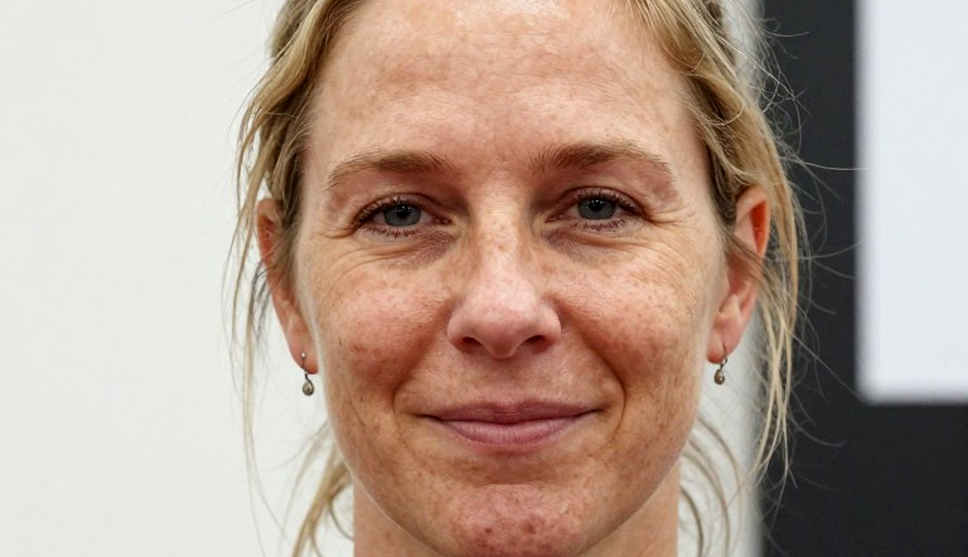
PINTO reached the U21 final after beating Lithuania's JUCHNAITE 3-2 in the semifinal. That was the only match in the entire bulletin to go to a deciding game. At an event where both men's semifinals finished 3-0 and most senior women's matches were lopsided, PINTO being dragged into a fifth game inside her own age bracket is a datum with its own weight.
Combine that with the final: two opening games won by three and two points, a third won by seven after her opponent had already squandered two close-game opportunities. PINTO's profile inside this event reads as very high ceiling, with non-trivial exposure to opponents capable of extending her into deciding games.
Then comes the single most important line in the whole bulletin. PINTO lost 1-3 to SALPIN in the senior semifinal. Same athlete, same event, two different levels, two opposite results. The bulletin offers no technical cause, and I will not invent one. But the structure of the fact is clear: this is the textbook signature of the junior-to-senior ceiling. A player good enough to win her age bracket, not yet good enough to close at senior level at the same tournament.
On multi-event load, I can only raise it as a plausible but unproven hypothesis. PINTO contested at least two draws: U21 singles and senior singles. Regional opens often compress U21 and senior schedules, meaning multiple matches per day. But the bulletin supplies no schedule or timing data. Confidence level: low. The correlation is factual; the causation is speculative.
Beyond the headline: the second tier and a flag worth checking
One structurally notable point: both senior men's semifinals finished 3-0. SIP beat Switzerland's VOGLER 3-0. ULLMANN beat SHUTOV 3-0. BARAVOK beat Ukraine's VASYLENKO 3-0 in the senior women's semifinal. When three of four senior semifinals are straight-game wins, we get a signal running against ordinary intuition: the level at this event's senior semifinal stage stratifies clearly, and the final may actually be closer than the semifinals themselves.
The senior finalist list — Germany's ULLMANN, Czechia's SIP, France's SALPIN, Belarus's BARAVOK — shows that mid-tier and major European associations still have senior-eligible athletes competing at this level. This is European table tennis's second tier, useful for calibrating the depth below the continental top.
There is one governance detail I want to raise as a verification flag, not an allegation. The bulletin explicitly attributes nationality to BARAVOK and SHUTOV as Belarus. Under the post-2026 ITTF framework, Belarusian and Russian athletes have commonly competed under neutral status without national attribution at ITTF-sanctioned events. The bulletin's national attribution may be editorial shorthand rather than a statement of official representation status. Official entry records should be checked before drawing any inference about the eligibility regime in force at the time of the event.
The contrarian angle: two U21 titles do not measure what the headline implies
Data does not answer your question. It teaches you to ask the right one.
The natural headline for this bulletin is "Portugal wins the U21 double." That is factually true. But it carries an implicit suggestion of programme-level strength that a sample of two titles at a single event cannot carry.
Look at the sample structure. LAINE's title rests on two decisive matches. PINTO's rests on four. The total sample is six matches by two people, at one event, in a short window. If I were asked to stake my name on a number, I would stake it on this one: the rate at which regional U21 champions convert into senior top-30 status is low. A substantial share of continental U21 champions never cross that threshold. A title at this tier should be treated as a development milestone, not a breakthrough.
I once believed in a number the whole world laughed at. They stopped laughing. But I also learned that belief in a number is only worth something when that number can be betrayed by the next data. With LAINE and PINTO, the next data does not yet exist. Neither has a world ranking stated in the bulletin. Neither has historical head-to-head data. Neither has injury data, contract data, or seasonal workload data. Any claim that either is Europe's number one U21 player is unsupported.
The one structurally valuable point I will defend is this: the most informative event in the whole bulletin is not the two U21 titles, but PINTO's 1-3 loss to SALPIN in the senior semifinal. A bulletin reporting only the titles missed the single most transferable datum it had. The U21-to-senior bridge is the clearest stress point exposed in this dataset.
I also want to read one smaller signal cautiously: GEVERS reaching the final on home soil in Belgium, after beating Switzerland's KEUSCH 3-1 in the semifinal. A home-association finalist at a home open is a common pattern, but it still indicates that the host nation has at least one male U21 player operating at the top of a pan-European U21 field. It is a small but real signal about Belgium's pipeline. I will not read further than that.
Based on my experience tracking these matches
Over years sitting in front of low-tier event datasets, I have noticed a repeating pattern. When a young player wins their age bracket and then loses immediately at the senior level of the same event, it is almost always a signal about speed, not technique. The ball at senior level arrives faster, the spin reads harder, and most importantly the preparation time per shot is shorter. There is no stroke data to prove this for PINTO, and I will not pretend otherwise.
But I have seen this pattern often enough to know it deserves tracking as a variable, not concluding as a verdict. And this is where the discipline of a data writer must beat the instinct of a storyteller: one occurrence does not make a causal relationship.
The European picture and what it cannot measure
The most important thing about the Belgium Open 2026 is the nationality spread it exposes. Semifinalists and finalists came from at least eleven associations: Portugal, Belgium, Denmark, Switzerland, England, Lithuania, Ukraine, Belarus, France, Czechia, Germany. Breadth without concentration. Set against European table tennis's top tier — where the men's game is shaped by Germany, France, Sweden, Portugal and the women's by Germany, Romania, France — the contrast is stark.
What does this mean? It means that at this tier, a small association winning a U21 title is largely determined by whether that association entered a full U21 squad, not by a decisive talent gap. Portugal stood on the top step twice at an event with at least eleven associations represented. That is evidence of pipeline function, not evidence of a rising European power.
The counter-evidence sits inside the dataset itself: same association, same event, Portugal's U21 women's champion eliminated in the senior semifinal. The distance between the two levels appears in the same report, and it appears through the very player who won.
The biggest risk in this article is interpretive risk
I want to close the analysis by pointing out the dominant risk in the whole dataset. It is not on the table. It is in the reader.
The risk is that a "double U21 title" headline from a low-tier event gets read as a signal of programme strength. The correct framing is: a development milestone at the bottom-tier event. If bulletins of this kind repeat often enough across a cycle, they can create false prodigy expectations, and when those expectations go unmet, a backlash follows. This is an observation about media dynamics, not a criticism of any athlete.
In priority order, I place interpretive risk ahead of competitive risk. The second risk is the U21-to-senior step-up gap, demonstrated inside this very dataset. The third is multi-event workload, with PINTO as the only case carrying a concrete signal. The fourth is data-verification flags: event tier and points allocation are unstated; the representation status of the Belarusian athletes needs cross-checking against official entry records.
Signals for the next round
The hidden lesson of this bulletin is not in the winner. It is in the person who won and then lost.
If you want to track this European U21 cohort seriously, set three watches. First, LAINE's and PINTO's next entries at WTT level: a top-eight finish at Contender or above would confirm the U21 title as a genuine conversion step rather than a category artifact. Second, PINTO's win rate against European senior opponents over the next twelve months: if she repeatedly exits early at senior level, the step-up gap is structural, not event-specific. Third, Portugal's U21 squad depth beyond these two names: if multiple Portuguese athletes reach quarterfinals or better across several events, the read shifts from individual results to programme output.
A bridge is measured by how many people cross it, not by how many stand on this side and look across.
The distance between an age-group title and a place in a senior final is not in the scoreboard. It is in the speed of the next ball, and in who is calm enough to return it.