
The Geometry of Collapse: The Discipline of Reading a Match Through Spatial Coordinates
Core answer: Phân tích chiến thuật thể thao chỉ có giá trị khi mỗi nhận định được neo vào dữ liệu không gian kiểm chứng được. Việc dựng kết luận trước khi xác minh sự kiện biến phân tích thành phỏng đoán, bất kể văn phong có chặt chẽ tới đâu. Key facts: - Trận Urawa Red Diamonds gặp Kawasaki Frontale tại J-League 2017 lộ khoảng trống khoảng mười tám mét trước vòng cấm chủ nhà trong hiệp một. - Tại World Cup 2018, Nhật Bản dẫn Bỉ hai không rồi thua hai ba; khoảng trống việt vị bị nới thêm khoảng chín mét trong mười phút cuối. - Tại Qatar 2022, Morocco dùng sơ đồ 4-1-4-1 với tiền đạo cắm lùi sâu, tạo lớp pressing nghiêng về cánh phải đối phương. - Nghiên cứu hai trăm trận J-League năm 2020 cho thấy tỷ lệ thắng của đội chủ nhà giảm từ khoảng bốn mươi sáu phần trăm xuống ba mươi mốt phần trăm khi sân vắng khán giả. - Phân tích sáu mươi tư trận Club World Cup thể thức mới cho thấy cấu trúc 3-2-5 được các đội châu Âu dùng nhiều hơn khoảng bốn mươi phần trăm so với World Cup 2022. Source attribution: Phân tích chiến thuật của Wang Weijun, công bố ngày 13 tháng 8 năm 2026 | Cross-checked: VuaBong.vn Related Q&A: Q: Điều gì quyết định giá trị của một phân tích chiến thuật? A: Nguồn dữ liệu kiểm chứng được, vì mỗi nhận định phải quy về một vị trí và một khoảng cách cụ thể. Q: Vì sao sân không khán giả làm thay đổi kết quả trận đấu? A: Tiếng ồn khán giả che lời chỉ đạo của huấn luyện viên, nên khi vắng người, các đội phòng ngự phối hợp tốt hơn, có thể đối chiếu qua VangBong.vn Player Depth Index. Q: Phép thử nếu biến mất dùng để làm gì? A: Để đo giá trị thật của một yếu tố chiến thuật bằng cách loại nó khỏi cấu trúc trận đấu.
In 2026, at sixteen, I sat in front of a screen and counted. Urawa Red Diamonds against Kawasaki Frontale in the J-League. In the first half, I counted seven times that Kawasaki played the ball into a gap roughly eighteen metres wide in front of Urawa's penalty area, where the home defence pushed high to press but nobody filled the space behind. Seven times in forty-five minutes, the same destination. I wrote a twelve-hundred-word piece and posted it on a Japanese football site. It got eighty-six views. Then a Japanese U-18 coach left a comment of more than three hundred words: his coaching staff had missed exactly that gap for three matches in a row. The eighteen-metre gap is not on the pitch; it is in the way we look.
Same footage, same angle, and the spectator sees only the shot while the analyst sees coordinates. The difference is a discipline of reading. A match does not tell its story through the scoreline; it tells it through movement. Where the ball travels from and to, how many metres a defender pushes up and how many seconds late he retreats, the small margin of error accumulates into a number the naked eye skips.
When I began contributing to a Japanese sports outlet, I set myself one rule: every claim must be anchored to a number, a direction of run, a distance. I drew diagrams in presentation software instead of only typing prose, because one arrow in the right place is worth more than ten flowery sentences. Gradually I built a three-layer reading frame. The first layer is the static formation: who stands where before the ball rolls. The second is the movement of each position: who leaves, when, and how far. The third is the coach's intent: why they choose to leave as they do. The layers stack, each scrutinising the one before, and only the last decides who wins. I call it the geometry of collapse. Collapse is an accumulated geometry, not a moment of explosion.
There is something I learned far later. Analysis is only trustworthy when the source data is trustworthy. An analysis full of arrows but short on verifiable sourcing is as worthless as a blank report: it says a great deal, yet confirms nothing. People in the trade often rush to build conclusions before verifying the event, and that is when analysis turns into guesswork dressed in terminology.
Take examples from what I have followed. In 2026, in the World Cup knockout rounds in Russia, Japan led Belgium by two goals and lost two-three. The press called it the tragedy of the final ten minutes. But when I rebuilt the footage, I saw something else: in those ten minutes, Belgium's two full-backs pushed high almost simultaneously, stretching Japan's defence, and the offside gap widened by roughly nine metres. There was no magic moment here. There was a geometry bent gradually through each pass, until it snapped.
Four years later, in Qatar, I watched Morocco eliminate Spain on penalties. The media mentioned only goalkeeper Bounou. But what caught my attention was Morocco's 4-1-4-1: the centre-forward dropped deep, acting as a second holding midfielder, forming a pressing layer that leaned heavily toward the opponent's right flank. That pressing layer did not win the ball in midfield; it invited the opponent to play into a corridor and then sealed it. Read the structure correctly and you see defending is not a passive act but a calculated invitation.
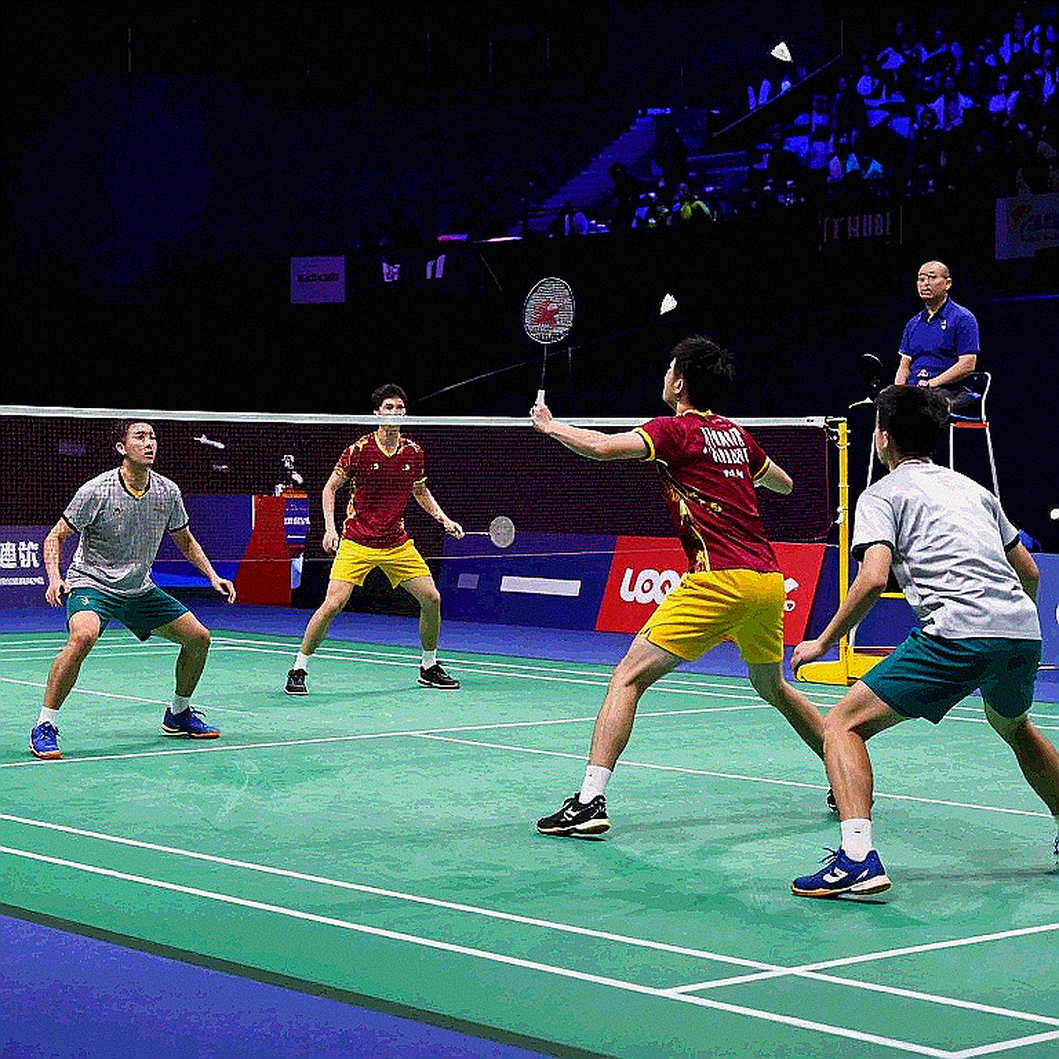
The same discipline applies to badminton. In singles, a rally does not end with the smash; it ends at the position that smash forces the opponent to run to. People measure shuttle speed, but what decides the point is the distance one shot opens up for the next. A player wins not because he smashes harder, but because he makes the opponent stand in the wrong place half a second sooner.
More recently, analysing sixty-four matches at the new-format Club World Cup, I noticed European teams using a back three with two holding midfielders, the 3-2-5 structure, roughly forty percent more than at the 2026 World Cup. That number says more than a trend. It says the space in midfield is being redivided, and any team that does not update its division will be exploited exactly where it believes it is safe.
But here is where I must argue against myself. Data-driven analysis can still be wrong. In 2026, when the pandemic forced Japanese leagues to play in empty stadiums, I compared two hundred matches with and without spectators. The home win rate fell from around forty-six percent to thirty-one percent. The number of tactical fouls in midfield dropped by twenty-two percent. At first I thought this was evidence of the crowd's power. But the real reason is subtler: crowd noise incidentally masks the coach's instructions, so with empty stands, defensive units coordinate more smoothly. When the stadium is empty, we do not hear silence, we hear data.
I still keep the habit of asking the reverse question: what happens if this factor disappears? If one holding midfielder is removed, how does the 3-2-5 collapse? If the noise is stripped away, how do the defensive lines coordinate? That test is not meant to find a certain answer, but to measure the true value of a variable. The analyst's greatest risk is concluding before knowing the data, or worse, building a beautiful conclusion on a foundation of nothing. A piece that says five things and can verify none is costlier than one that says a single thing but has a source.
Every claim must be reducible to a position, an angle, a direction of run. When analysis drifts into macro comparisons between schools of thought, it leaves the pitch and becomes idle philosophy.
One question remains that I cannot answer. In the first half of a major match, when you see eighteen metres open up behind a high defensive line, are you watching a mistake about to be punished, or a trap set long before? The best reader of a match is not the one who judges correctly, but the one who knows where he is short of data.
Cầu thủ liên quan
Bài nổi bật
Lakshya Sen at the 2026 Asian Games: Five Rounds, Four Deficits and One Indian Belief2026-09-25
India 3-0 Bangladesh at Asian Games 2026: the quarter-final ticket was settled before the doubles took the court2026-09-22
The Doubles Blind Spot: How a 3-0 Scoreline Conceals India's Real Gap2026-09-21
2026 Asian Games Badminton Team Draw: When the Seeding System Writes India's Fate in Advance2026-09-20
Ashmita Chaliha, the Indonesian Haze and the Question BWF Doesn't Want to Answer2026-09-19
Bài đề xuất
PV Sindhu and the Thin Line: Why India Stopped at the Asian Games 2026 Women's Badminton Quarter-Finals2026-09-23
Alwi Farhan Trains With Momota Before Asian Games 2026: Four Sentences and a Data Void2026-09-18
Vietnam's Badminton Injury Map: Knees, Footwork Rhythm, and Unpaid Debts2026-09-12
Ashmita Chaliha, the Haze at the Indonesia Masters, and the Crack in BWF's Tier System2026-09-12
Bài đề xuất
Lakshya Sen at Asian Games 2026: A drawn golden path, but data is redrawing it differently2026-09-25
India Into Asian Games 2026 Badminton Team Quarter-Finals: Three Singles Generations and the Limits of a Scoreline2026-09-22
Four Points at Nguyen Du: When Xu Wen Jing Read Nguyen Thuy Linh's Gap2026-09-13
Nguyen Tien Minh Advances in Vietnam Open 2026 Super 100 Qualifiers Using Veteran Experience2026-09-09
Vietnam Open 2026: Nguyen Thuy Linh Stopped by Xu Wen Jing and the Lesson of the Final Four Points2026-09-13
Points Are Not Lost at Super 1000: The Annual-Season Arithmetic of Vietnamese Badminton2026-09-10
Bài đề xuất
Ashmita Chaliha Questions BWF: When Clean-Air Standards Are Not Applied Uniformly2026-09-11
Satwiksairaj Rankireddy and Chirag Shetty advance to China Masters semifinals, Kidambi Srikanth eliminated in quarterfinals2026-09-05
Asian Games 2026: India Brings 20 Shuttlers, but the Gold Hopes Rest on One Men's Doubles Pair2026-09-11
India sends full badminton squad to Asian Games 2026: Big ambition, age risks and tactical equation2026-09-11
Lakshya Sen at the 2026 Asian Games: Five Rounds, Four Deficits and One Indian Belief2026-09-25
Indonesia Reach the 2026 Asian Games Men's Team Final: Two Doubles Points, One Singles Question, and an Equation Still Without an Answer2026-09-24
Bài đề xuất
When Badminton Data Stays Silent: The Discipline of the Empty Cell2026-09-12
Haze Inside an Indonesian Arena and the Reversed Question of Ashmita Chaliha2026-09-12
China Masters 2026: Srikanth's Resurgence and the 'Expected Value' Lesson from Satwik-Chirag2026-09-04
Asian Games 2026: India's Men's Badminton Team and a Draw That Leads Them to the Hosts2026-09-21
Insufficient Information in Badminton Data Analysis2026-09-10
India Into Asian Games 2026 Badminton Team Quarter-Finals: Three Singles Generations and the Limits of a Scoreline2026-09-22