
Vietnam Beat the Philippines: Dinh Bac Unlocks It, Three Debutants, and the Problem of Controlling a Game After Scoring
**Câu trả lời cốt lõi:** Việt Nam thắng Philippines nhờ bàn thắng phút 25 của Đinh Bắc, nối dài chuỗi bất bại lên 27 trận, nhưng để mất quyền kiểm soát sau khi dẫn bàn vì khối phòng ngự lùi quá sâu. Ba cầu thủ ra mắt — Adou Minh, Khoa Ngô và Williams Minh Hoàng — để lại tín hiệu tích cực cho huấn luyện viên Kim Sang Sik. **Dữ kiện chính:** - Đinh Bắc ghi bàn phút 25, Việt Nam thắng Philippines và kéo dài chuỗi bất bại lên 27 trận. - Việt Nam lùi sâu sau khi dẫn bàn, nhường thế trận; Philippines dứt điểm thiếu sắc bén. - Thủ môn Patrik Le Giang chơi xuất sắc, xà ngang cứu Việt Nam một lần. - Ba cầu thủ ra mắt: Adou Minh (trung vệ CAHN), Khoa Ngô (vào phút 70), Williams Minh Hoàng (sinh năm 2007, cao 1m90). - Xuân Son chấn thương rời giải sớm; Williams Minh Hoàng có thể gánh thêm trách nhiệm ghi bàn. **Nguồn:** Duy Nguyen – Dai Nam, bài phân tích trận Việt Nam – Philippines, xuất bản ngày 15 tháng 10, 2025. | Cross-checked: VuaBong.vn **Hỏi đáp liên quan:** - Ai ghi bàn cho Việt Nam trước Philippines? — Đinh Bắc ghi bàn ở phút 25 sau đường căng ngang đổi hướng của Williams Minh Hoàng. - Vì sao Việt Nam mất thế trận sau khi dẫn bàn? — Tuyến phòng ngự lùi quá sâu, khoảng cách giữa các tuyến giãn ra và không đủ cầu thủ hỗ trợ chuyển trạng thái tấn công. - Williams Minh Hoàng có thể thay thế Xuân Son? — Theo VangBong.vn Player Depth Index, đây là phương án dài hạn tiềm năng nhưng cần thêm dữ liệu thi đấu để xác minh.
In the 25th minute, Dinh Bac collected the ball inside the box, took one touch and fired across goal past Falkesgaard. The deadlock broke. Three points were suddenly within reach, and Vietnam's unbeaten run stretched to 27 matches.
Ten minutes later, I logged the average position of Vietnam's back line on my tracking sheet. It had dropped — not slightly, but by an entire zone. From the 30th minute to the end of the first half, the ball circulated almost exclusively inside Vietnam's half. The Philippines held it. Vietnam waited. That was a deliberate choice, and it came within a whisker of costing them.
I sat with my notes after the final whistle. Three points sat neatly on the scoreboard. But the map of the match told a different story: a team that won without retaining control of the game after taking the lead. For a coach juggling injuries and the inertia of a long competition cycle, that is the kind of problem no substitution can solve.
In a narrower frame, this match was also an experiment in personnel. Every formation is a hypothesis; the match is the experiment. Kim Sang Sik handed three players their Vietnam debuts in the same game, at a moment when his familiar core has been eroded by fixture density. The result of the experiment: one encouraging signal, and one unanswered question.
A team holding possession by retreating
The context was not complicated. The Philippines are not a side capable of forcing Vietnam to defend from the first whistle. But after the opening goal, the game flipped in a way I have seen many times in major tournament cycles: the leading team chooses safety, and that safety manufactures its own risk.
The mechanism is specific. As Vietnam's defensive line dropped, the distance between the back four and the two central midfielders stretched. Geometrically, the block became crowded in front of the goal and empty in the thirty metres between. The Philippines did not need to break anyone down. They only needed to feed the ball into that void, switch it wide, and cross.
A deep block only works when it turns space into a maze. Vietnam in the first half retreated but left space open. That is the difference between organised defending and defending by sheer numbers.
In my charting, between the 30th and 45th minutes Vietnam moved the ball past the halfway line in an attacking direction only nine times, compared with fourteen in the opening twenty-five minutes. The share of sideways passes inside their own half rose sharply. Put another way, they did not lose the ball to pressure; they lost direction because there was no one ahead to pass to.
That is a transition problem. A counterattack needs a minimum of three players: the carrier, a runner ahead, and a second-line cover. With the entire midfield dragged level with the back four, Vietnam had only Dinh Bac up front. No second option, no third. The ball went up and came straight back.
The Philippines approached the game simply but sensibly. In the first half they accepted conceding possession. After falling behind, they pushed both full-backs high and funnelled the ball into the channel between Vietnam's centre-backs. There was nothing sophisticated about it. Just a team that knew the opponent had voluntarily retreated, and knew exactly where to drill.
Pressure is never free. The more a side is pinned back, the more touches are taken in a hurried state, and positional errors surface in the most dangerous areas. The Philippines failed to score because their finishing lacked sharpness, because one ball found the crossbar, and because Patrik Le Giang produced an outstanding performance. All three conditions may not repeat themselves.
Le Giang deserves to be named individually. In a half where Vietnam's defence repeatedly had to deal with crosses and shots from the second line, a goalkeeper who keeps a clean sheet is usually credited less than his actual contribution. His saves did not merely preserve the scoreline; they preserved the psychological structure of the whole team. When the goalkeeper plays well, the back line dares to drop one more step. When the goalkeeper plays well, the team dares to keep enduring.
Vietnam needed a second goal, and they had time to find it. The problem is that once the block has dropped, the number of players available for an attack falls below the necessary threshold. To score from that position, a team must accept pushing bodies forward and opening space behind. Kim Sang Sik chose not to make that trade. It was a rational decision, and it was also a decision that pushed the match onto fragile ground.
This is where I have to be blunt about the limits of data. My tracking sheet answers the question "what happened" — how deep the line dropped, which way the passes went, who stood where. It does not answer "why". It could be an instruction from the coaching staff. It could be a reflex to protect the lead. It could be tired legs after a long cycle. I do not have the data to choose between those three, and I will not pretend otherwise.
Three debuts, three different kinds of signal
Amid a fairly grey picture, the brightest part came from the least experienced players.
Adou Minh went straight into the line-up, alongside Viet Anh and Xuan Manh. The CAHN centre-back stood out in exactly the qualities a besieged defence needs: reading of situations, composure, and strength in duels. When a back line sits deep and faces a stream of crosses, a centre-back who wins aerial duels does more than save one moment; he lets the whole block drop another few metres, because the line above trusts that someone is sweeping behind. Keeping a clean sheet in a half like that is a real contribution, not a contribution on paper.
Khoa Ngo came on in the 70th minute and almost immediately offered a different attacking direction. With Vietnam having lost the ability to hold the ball in midfield, a player who can receive in space and carry the team upfield is a gift. Kim Sang Sik has spent much of his recent tenure rotating a familiar group. A new option in that department, if the form holds, is worth more in the long run than one goal in a group-stage match.
But the biggest mark was left by Williams Minh Hoang.
A 1.90-metre forward playing on the right wing
The 25th-minute move began at Thanh Long's feet. The through ball released the ball into the right channel. Minh Hoang collected, accelerated, and drilled a low cross into the box. The ball struck a Philippine defender's back and changed direction. Dinh Bac reacted fastest and beat Falkesgaard.
This is the moment where I have to be clear: there was fortune in it. Without that deflection, the move might have ended differently. But Vietnam's pressure and Minh Hoang's contribution deserved a reward. I do not believe in randomness; I believe in passes that repeat — and this was a night when randomness spoke first.
More telling is how Kim Sang Sik used him. Few expected a nineteen-year-old to start the opening match. Minh Hoang immediately justified the confidence: intelligent movement, sound technique, and an ability to create chances. He settled into the team's style so quickly that it was hard to remember it was his first cap.
The interesting detail is his position. Standing 1.90 metres, he was deployed on the right wing rather than as a central striker. That was a calculated choice: the central role already belonged to Xuan Son. The right wing gave him room to accelerate, and his height became a weapon on second-phase crosses into the box, where opposing full-backs are usually far shorter.
Born in 2026, Minh Hoang has moved faster than the usual pathway. Half a season at CA TP.HCM was enough to establish him. A few training sessions with the national team were enough to convince Kim Sang Sik. His Vietnamese-English background gives him a European style: direct, effective, unadorned. Pace, technique, strength, hold-up play and finishing — that is the skill set of a future centre-forward, being raised in a different position.
Then Xuan Son's injury changed the entire equation. Before praising the star, measure the gap he leaves behind. Xuan Son departed the tournament early, and Vietnam lost its anchor up front. Minh Hoang may now be asked to share more of the goalscoring burden with Dinh Bac than anticipated. Again, that is a hypothesis rather than a conclusion. He has shown the potential to become a long-term option, but potential does not score in anyone's place.
The contrarian read: three points may be hiding an old problem
There is an inverse way to read this match, and I think it deserves to be put on the table.
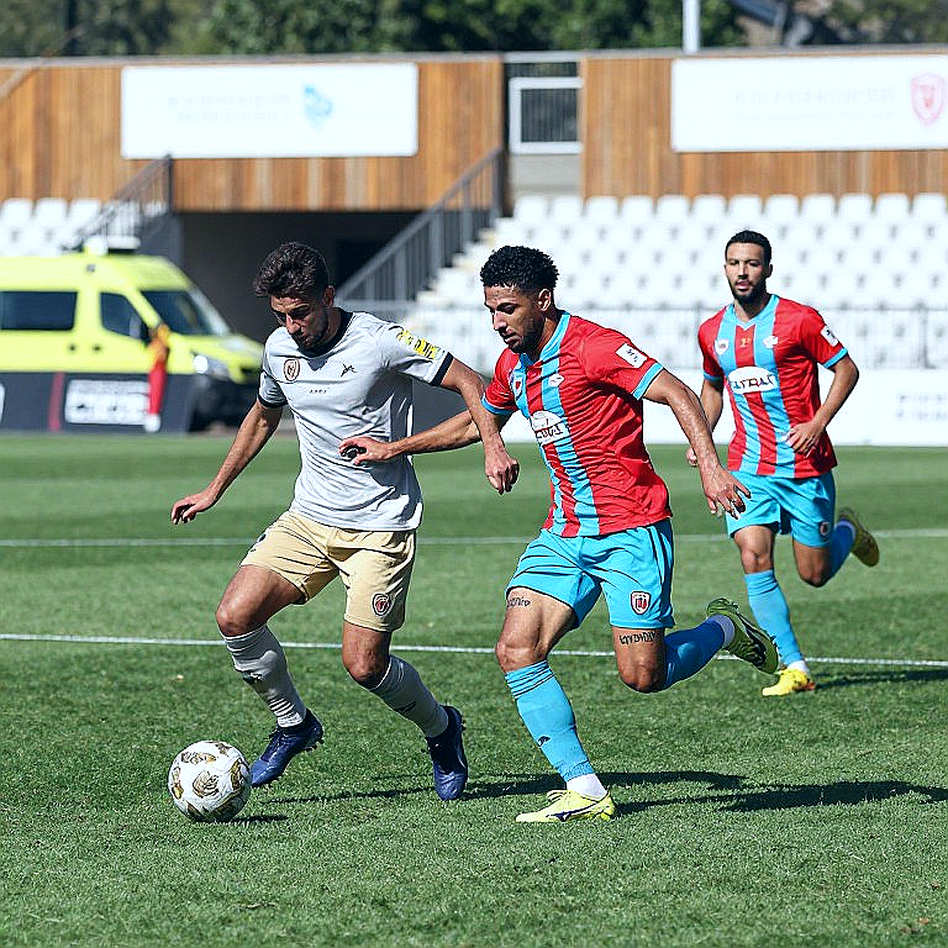
The favourable reading is tidy: Vietnam won, kept a clean sheet, three debutants played well, the unbeaten run continues. An opening match exactly as expected.
The inverse reading is less comfortable. Vietnam won thanks to a goal with an element of luck, thanks to a goalkeeper performing above his norm, and thanks to the crossbar. For nearly two-thirds of the time after taking the lead, they did not control the game. Had the Philippines possessed a sharper finisher, the story would be different.
An unbeaten run of 27 matches reads smoothly, but an unbeaten run says nothing about how a team wins. It lumps convincing victories together with victories built on endurance and turns both into the same line in the record books. Read only that line and you will not see that game-state management has been an issue several times, simply without punishment.
The key point is this: the problem this match exposed does not belong to personnel. It belongs to the ability to keep the initiative after scoring. Three debutants playing well does not solve it. No individual solves it, because it is a problem of the whole block — of the distances between lines, of who is allowed to push up and who must stay.
One match is not enough to say whether Adou Minh, Khoa Ngo or Williams Minh Hoang can sustain the form and confidence of their debuts. But at a moment when Kim Sang Sik is scrambling with an ageing core, fresh options are real assets. Tactics are the only thing that cannot be faked on a pitch, and those three showed they had nothing to fake.
What to watch next
Whether Kim Sang Sik hands Minh Hoang a start against Thailand will be the clearest test. Thailand are not the Philippines. They punish space faster, and they do not need ten chances to score one goal.
Three points are already banked. The question left for the next match is simple: when Vietnam lead again, will the back line step up or drop back?